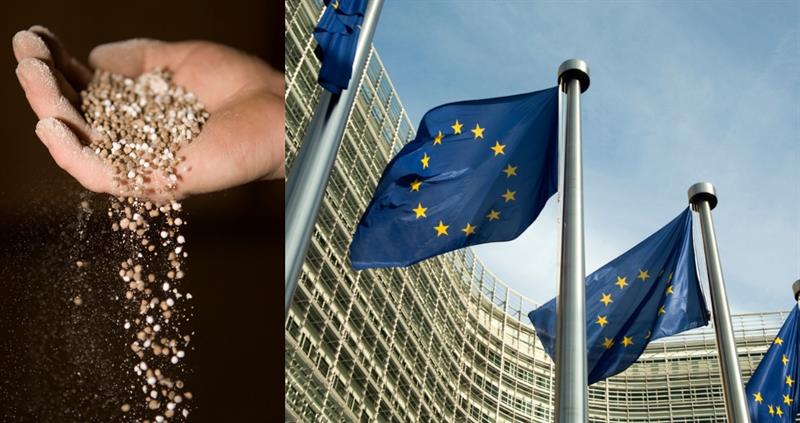
The Carbon Border Adjustment Mechanism (CBAM) is the EU's tool to put a fair price on carbon emitted during the production of carbon-intensive goods that are entering the EU, and to protect European businesses from the competition of imported products with higher greenhouse gas (GHG) emissions. The CBAM came into full financial and operation enforcement from 1 January 2026, after a transitional reporting phase between 2023 to 2025. The CBAM puts a price on carbon emitted during the production of carbon-intensive goods (iron, steel, cement, fertilizers, hydrogen, electricity) imported into the EU. It ensures importers face costs equivalent to EU producers under the Emissions Trading System (ETS), encouraging global decarbonization.
Fertiliser in scope of CBAM
Although agriculture is not directly included in the CBAM, fertiliser products are. Most emissions are associated with the production of nitrogen-based fertilisers, which usually involves a process involving natural gas as the feedstock. However, the embedded carbon of fertilisers varies from product to product. The main types of fertilisers are:
- Ammonia
- Urea
- Nitric acid
- Sulphuric acid
- Nitrates of potassium
Mixed fertilisers containing:
- Nitrogen (N)
- Phosphorus (P)
- Potassium (K)123
The EU is heavily dependent on fertiliser imports: in 2021, 30% of its nitrogen consumption was imported. These imports come mainly from Russia, Belarus, Egypt and Morocco. The EU also has a domestic fertiliser production industry, spread over 120 sites, which generated an average of 40.2 Mt of products per year from 2019 to 2021. Around a third of this production is destined for export. In 2021, the EU accounted for 9% of global nitrogen fertiliser production. The industry remains fragile because of its heavy dependence on natural gas (80% imported) which is used for production.
Since January 2026, companies importing fertiliser into the EU have to purchase CBAM certificates to cover embedded emissions, with the cost based on the weekly average EU ETS carbon price. EU importers must report quarterly on the quantities of fertilisers goods they import into the EU, the greenhouse gas emissions released as they were produced (embedded in those goods).
- In order to find out if the goods you produce fall under the scope of the CBAM, you may use the TARIC consultation tool.
- EU importers or their indirect customs representatives importing more than the single mass-based threshold of 50 tonnes of CBAM goods into the EU will have to apply for the status of authorized CBAM declarants. They will buy CBAM certificates from the national authorities in their country of establishment. The price of the certificates will be calculated based on auction price of EU ETS allowances expressed in €/tonne of CO2 emitted, as a quarterly average in 2026 and as a weekly average from 2027 onwards.
- EU importers will declare the emissions embedded in their imports and surrender the corresponding number of certificates each year.
- If importers can prove that a carbon price has already been paid during the production of the imported goods, the corresponding amount can be deducted.
How much will the CBAM add to the cost of fertiliser?
With the increase in the relative price of imports, due to the cost of acquiring carbon certificates (the price of which is expected to increase by more than 10% between now and 2040), imports are expected to fall. European production of fertiliser should also continue to decarbonise, due to the abolition of free allowances and the price signal from the ETS. The price of carbon could rise to €160/t by 2030. Fertilisers based on green ammonia, produced from hydrogen derived from decarbonised energy, are expected to gradually become profitable and mass-produced. However, the European industry could lose competitiveness on the export market as a result of higher production costs. Additional carbon emissions could occur on third markets as a consequence, where European low-carbon fertilisers would be replaced by non-European fertilisers with higher emissions and lower prices, as they would not be subject to the same carbon price.
There is significant concern over the fact that the European Commission will only set the price of certificates retrospectively, i.e. the price of certificates for quarter one of the year will not be known until quarter two, and so on. Concerns have frequently been highlighted over fertiliser suppliers being asked to provide quotes for supplies without knowing what the cost of the CBAM certificates for those supplies will be.
What does this mean for farmers?
As imports of carbon-intensive fertilizers are taxed, EU farmers are likely to face increased procurement costs for these vital inputs as importers pass this cost onto farmers. Farmers in Ireland are reporting a 35% rise in the cost of urea fertiliser.
COPA-COGECA, of which BAB is a member, has warned of an 80% decrease in January nitrogen fertiliser imports to the EU. COPA-COGECA said that a January 2026 import figure of just under 180,000t of nitrogen fertilisers imports appears as a “harsh reality that is now knocking at the EU’s door”. The equivalent chemical nitrogen fertiliser import figure for January 2025 was 1.18M/t. COPA continues to call for wants the implementation of CBAM for fertiliser to be paused due to the drop in fertiliser imports. “Among the key demands voiced in the December and January protests were postponing CBAM implementation for fertilisers until technical conditions ensure price predictability at import and invoicing, avoiding supply disruptions throughout the chain, and introducing long-term measures to offset CBAM-related costs for farmers. The data now leave no room for doubt. When imports collapse by more than 80%, when prices continue to rise and availability becomes uncertain, this is no longer a theoretical concern. It is an immediate risk to EU agricultural production and food security.”