Gene-Edited Plants greenlit for EU
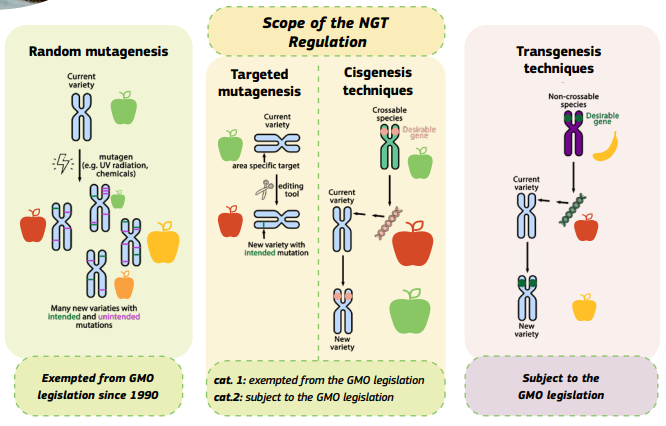
The new EU regulatory framework for NGT plants will replace the previous situation where most gene-edited plants were regulated under the same strict rules as GMOs. The framework recognises that some NGT plants contain genetic changes that could also occur naturally or through conventional breeding. These plants (NGT Category 1), following a verification procedure, are treated in the same way as conventional plants. NGT-derived plant products are already available outside the EU, including crops with improved resistance to drought, pests and diseases, and products designed to reduce food waste.
Other NGT plants (NGT Category 2), which contain more complex genetic modifications, remain subject to GMO legislation. They require risk assessment, authorisation and GMO labelling before they can be placed on the market.
Category 1 NGT plants
- equivalent to conventional plants and plants obtained through conventional breeding
- subject to a verification procedure
- treated like conventional plants (not subject to the requirements of GMO legislation) and requires no labelling of product (other than the original seed)
Category 2 NGT plants
- more complex genetic modifications
- subject to GMO legislation
- requiring GMO risk assessment, authorisation, traceability and labelling
The EU agreed that certain traits cannot qualify for the NGT-1 regime including: Herbicide tolerance traits and production of known insecticidal substances. Plants containing these traits will automatically fall into the stricter NGT-2 category.
Organic
NGT plants will be prohibited in organic production. For NGT Cat-2 plants subject to authorisation, the legislative proposal maintains the traceability and labelling requirements of the GMO legislation. Today, GMOs are banned in organic production by the EU Organic Production Regulation. In addition, the proposal makes the adoption of coexistence measures at national level mandatory. Member States must adopt measures so that different types of cultivation can exist side by side, e.g., distances between the fields.
To exclude NGT plants from organic production, even those that have been verified to be comparable to conventional plants, organic and GM-free farmers can consult a public register of all NGT products and seed labelling in common catalogues of varieties.
Protection of intellectual property (IP)
Alongside labelling, protection of IP has been one the thorniest issues in the negation of this file. The agreement reached attempts to strike a balance between the concerns of plant breeders and farmers. Patent rules are governed by the EU's Biotech Directive, and when applying to register a category 1 NGT plant or product, companies or breeders must submit information on all existing or pending patents. The patenting information must be included in a publicly available database. Furthermore, on a voluntary basis, companies or breeders can also provide information on the patent holder's intention to licence the use of a patented NGT 1 plant or product, under equitable conditions.
The Council and the Parliament agreed on the creation of a patenting expert group, focusing on the effect of patents on NGT plants, composed of experts from all member states, the European Patent Office and the Community Plant Variety Office. One year after the entry into force of the regulation, the Commission will publish a study on the impact of patenting on innovation, on the availability of seeds to farmers and on the competitiveness of the EU plant breeding sector. The Commission will then indicate what follow-up measures are needed or publish a legislative proposal to address any issues found in the study.
Feature |
EU NGT Regulation |
England Precision Breeding Act 2023 |
|
Legal instrument |
EU Regulation (directly applicable across 27 Member States) |
National Act applying only in England |
|
Current status |
Political agreement reached; formal adoption pending |
In force; plant regulations operational |
|
Organisms covered |
Plants only (initially) |
Plants and vertebrate animals in force (secondary legislation for animals not presented)) |
|
Key concept |
“New Genomic Techniques (NGTs)” |
“Precision-bred organisms (PBOs)” |
|
Core test |
Whether genetic change could occur naturally or via conventional breeding |
Same core principle: changes that could arise naturally or by traditional breeding |
|
Categorisation |
Two tiers: NGT-1 (lighter regime) and NGT-2 (full GMO regime) |
No formal tiers; binary decision (precision-bred or GMO) |
|
GMO treatment |
NGT-1 treated like conventional plants; NGT-2 remain GMOs |
Precision-bred organisms are not GMOs |
|
Risk assessment |
NGT-1: verification only NGT-2: full GMO risk assessment |
Simplified, proportionate assessment for PBOs |
|
Food labelling |
NGT-2: mandatory GMO-style labelling NGT-1: generally not labelled at food level |
No mandatory labelling of precision-bred food |
|
Seed labelling |
Required for NGT-1 seeds |
No dedicated seed labelling regime |
|
Traceability |
Public databases; formal traceability for NGT-2 |
Public register of approved PBOs |
|
Member State flexibility |
States may opt out of cultivating NGT-2 plants |
No internal opt-out (England only framework) |
|
Patent transparency |
Disclosure of patent status required |
No special patent disclosure requirement |